

Most business owners do not fall behind on their books because they are careless. They fall behind because a busy season hit, a bookkeeper quit or the bank feed broke in March and nobody noticed until October. Then tax season arrives and the problem has a deadline attached to it.
This guide explains what catch-up bookkeeping actually involves, what drives the price, what paperwork you need to pull together and how to pick someone who will leave your books in better shape than they found them. If your books exist but are full of errors, keep reading, because that is a related job called cleanup and this guide covers it too.
TL;DR
- Catch-up means the bookkeeping was never done and cleanup means it was done wrong and plenty of businesses need both.
- Your account count, transaction volume, payroll, loans and how messy the records are drive the size of the job.
- Download every bank and card statement for the period before anyone touches the software, because missing records are the biggest delay.
- Go oldest month forward, reconcile each month fully before starting the next and fix the balance sheet last.
- Catch-up is billed separately from monthly bookkeeping, so insist on a diagnostic review and a not-to-exceed number before signing.
- The IRS failure to file penalty runs 5% of unpaid tax per month up to 25% and a cheap bookkeeper costs more once someone has to redo the work.
Catch-Up vs. Cleanup Bookkeeping: They Are Not the Same Job
This is the single most common mix-up and it is the reason so many quotes come in wrong.
Catch-up bookkeeping means no bookkeeping was done for a stretch of time. There are months with nothing recorded at all. The work is entering every transaction, putting each one in the right category and reconciling the accounts. Reconciling simply means checking your books against your bank statement, so both agree on the ending balance. Most catch-up work gets rebuilt from bank statements because that is the only complete record of what happened.
Cleanup bookkeeping means the books exist but they are wrong. Common problems include duplicate entries, expenses filed under the wrong category, accounts that were never reconciled, loan payments recorded as expenses instead of loan repayments and a balance sheet that no longer makes sense.
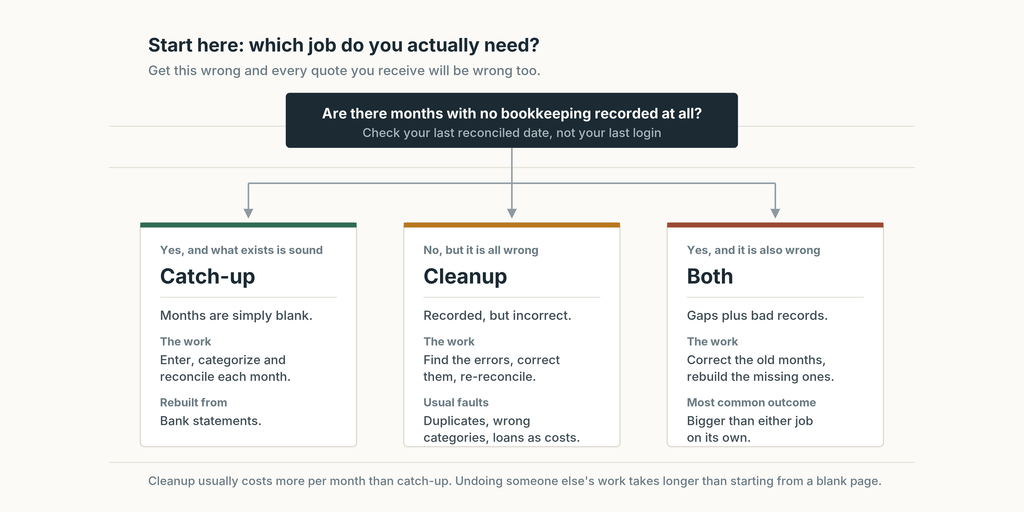
Cleanup is usually the harder of the two. Catch-up starts from a blank page. Cleanup means figuring out what someone else did, why they did it and what breaks if you undo it. One error repeated all year can affect every month’s reports.
Plenty of businesses need both at once. Six months of missing records plus a year of miscategorized transactions is a bigger project than either piece on its own.
Watch for this: If a provider gives you a price without asking whether you need catch-up, cleanup or both, they are guessing. That quote will change later.
How Far Behind Are You and How Messy Is It?
Twelve months behind sounds like a specific amount of work. It is not.
If there are two businesses, both twelve months behind. The first is a solo consultant with one business checking account and about 40 transactions a month. The second is a small HVAC company with two bank accounts, a business credit card, payroll for four people and an equipment loan. Same twelve months. Completely different projects.
What actually drives the size of the job:
- Number of accounts: Every bank account and credit card has to be reconciled separately, every month.
- Transaction volume: 40 a month and 400 a month are not comparable.
- Payroll: Wages, taxes and filings add real complexity.
- Loans: Each payment splits between principal and interest and has to be recorded correctly.
- Inventory: Businesses holding stock need counts and cost tracking.
- Sales platforms: Shopify, Amazon, Square and Stripe all deposit in batches with fees taken out, which takes extra work to unpack.
- Entity type: Sole proprietors are simpler. S-corps, partnerships and multi-entity setups involve distributions and owner compensation rules.
How big is your catch-up, really?
Months behind is the number everyone quotes. It is not the number that sets the price. Answer six questions to see what a bookkeeper will actually be looking at.
Answer all six to see your result.
Months behind multiplied by accounts. This is the unit of work, and it is what you should divide any quote by to compare providers fairly.
This is an estimate for comparing quotes, not a quote. Ranges reflect published 2026 US market pricing for catch-up and cleanup work. Your actual scope depends on what a review of your file turns up. Penalty figures referenced elsewhere in this guide come from the IRS.
Then there is condition. Books that are simply behind cost less to fix than books that are behind and wrong. What makes them wrong is usually personal and business spending mixed in the same account, bulk imports where everything landed in "Uncategorized," duplicate entries from a bank feed that was connected twice and stretches where the feed dropped and nobody noticed.
What Records You Need Before You Start
Missing paperwork is the number one reason catch-up projects run long. Gather this first:
- Bank statements for every month in scope, for every account.
- Credit card statements for the same period.
- Loan statements and the amortization schedule, which is the document showing how much of each payment is principal and how much is interest.
- Payroll reports and any filed payroll tax forms.
- Your last filed tax return.
- Records of anything large you bought, such as vehicles or equipment.
- Exports from any sales platform you use.
- Receipts for large or unusual purchases.
Note the order. Bank statements first, receipts second. Statements are the backbone of the rebuild because they are the complete record. Receipts are supporting detail for individual items.
Worth knowing: The IRS generally expects you to keep supporting records for three years and employment tax records for at least four years. (IRS Recordkeeping)
One more thing. Owning QuickBooks is not the same as having books. Connected bank feeds pull transactions in, but nothing is categorized or reconciled until a person does it. Many owners who feel stuck are looking at a file full of imported data with no actual bookkeeping behind it.
How to Catch Up on Bookkeeping Quickly
If you are doing this yourself, work in this order. Skipping steps is what turns a two-week job into a two-month one.
Step 1. Set your start and end dates: Find the last date anything was properly reconciled. That is your starting line.
Step 2. Download every statement for the period: Do this before you touch the software. Chasing one missing statement in month seven stalls everything after it.
Step 3. Work oldest month forward, one month at a time: Do not bulk categorize a full year at once. Errors made in bulk get repeated across every month and take longer to unwind than they took to create.
Step 4. Reconcile every account, every month, before moving on: A month is not finished until your books match the statement exactly. If it does not tie out, the problem is in that month and it is far easier to find now than six months later.
Step 5. Fix the balance sheet last: Once the months are reconciled, sort out loan balances, owner draws, credit card balances and any leftover opening balance equity.
Step 6. Close the period and set up a routine: Lock the finished months so nothing changes accidentally, then pick a fixed day each month to do the close.
DIY makes sense for a short backlog with one account and low volume. Hand it over when payroll, inventory, multiple years, sales tax or any client-funds account is involved.
When a Simple Catch-Up Turns Into Something Bigger
Nobody knows how bad a set of books is until they are inside the file.
A common example: a law firm needs three years of catch-up. Straightforward transaction entry or so it seems. Then the bookkeeper finds that the client trust account was never reconciled. Trust money belongs to clients, not the firm and it has strict rules. The job stops being data entry and becomes specialized reconstruction work.
Other surprises that show up regularly include unfiled payroll or sales tax returns, a growing undeposited funds balance, loan proceeds recorded as income, inventory that was never counted and prior-year tax returns that no longer match the books.
This is why a short diagnostic review should come before any fixed quote. It protects you as much as the provider. A price quoted without looking at the file is a guess and guesses get revised upward mid-project.
Ask directly: what happens if you find something outside the original scope?
If you are not sure which category your own books fall into, that is exactly what a books assessment is for. You find out what is actually wrong before any money changes hands.
What Catch-Up Bookkeeping Costs
Published market ranges in 2026 run roughly $300 to $3,500 for shorter, simpler backlogs and $1,500 to $6,000 or more where there is payroll, multiple accounts or several years involved. As one data point, Bookkeeper360 charges $1,000 and up for its onboarding and prior bookkeeping add-on. (NerdWallet)
Is $2,500 for one year reasonable?
It depends entirely on what is in that year. For a single account with low volume, that is high. For two accounts with payroll and a loan, it is normal. A useful way to judge is cost per account-month. One year with three accounts is 36 account-months to reconcile, so $2,500 works out to roughly $70 each. That is a fair benchmark to compare quotes against.
Why is catch-up billed separately from my monthly fee?
This is where most disputes start. A bookkeeper quotes $1,000 a month, then adds $4,000 to catch up the four previous months and the client feels blindsided. The monthly fee maintains a file that is current and reconciled. Catch-up rebuilds a file that is not. They are different work. The failure in that scenario is usually explanation, not price.
It helps to see how ongoing work is normally priced. Our monthly bookkeeping plans are built around the same two factors that drive catch-up cost, which are transaction volume and number of accounts:
| Plan | Price | Built for | Transactions | Reconciliations |
|---|---|---|---|---|
| Starter | $150 / month | Startups and small businesses | Up to 200 per month | 1 bank account, 1 credit card |
| Growth | $350 / month | Growing businesses | Up to 500 per month | 3 bank accounts, 3 credit cards |
| Elite | $600 / month | Established businesses | Up to 700 per month | 4 bank accounts, 4 credit cards |
Growth and Elite add accounts payable and accounts receivable, and all three plans include a free business tax return.
Read those tiers next to the complexity list from earlier and the logic becomes clear. Price tracks accounts and volume, not the calendar. That is also why a plan cannot cover months that are already behind. Ongoing bookkeeping keeps a current file accurate from the day you start. Catch-up rebuilds a file that does not exist yet, so it is scoped and quoted as a one-time project on top of whichever plan you move onto afterward.
Which pricing model to accept?
Hourly with no cap is the risky one, because you find out the total when the invoice arrives. A fixed project fee after a diagnostic review is best. If a provider will not give you a not-to-exceed number after reviewing your file, treat that as a warning sign.
Define "done" in writing. Finished should mean every account reconciled through a stated date, a documented and accurate opening balance for ongoing work and books your CPA can file from without redoing entries.
Behind on Bookkeeping for Taxes: What Is Actually at Risk
Late books create tax costs and it compounds monthly.
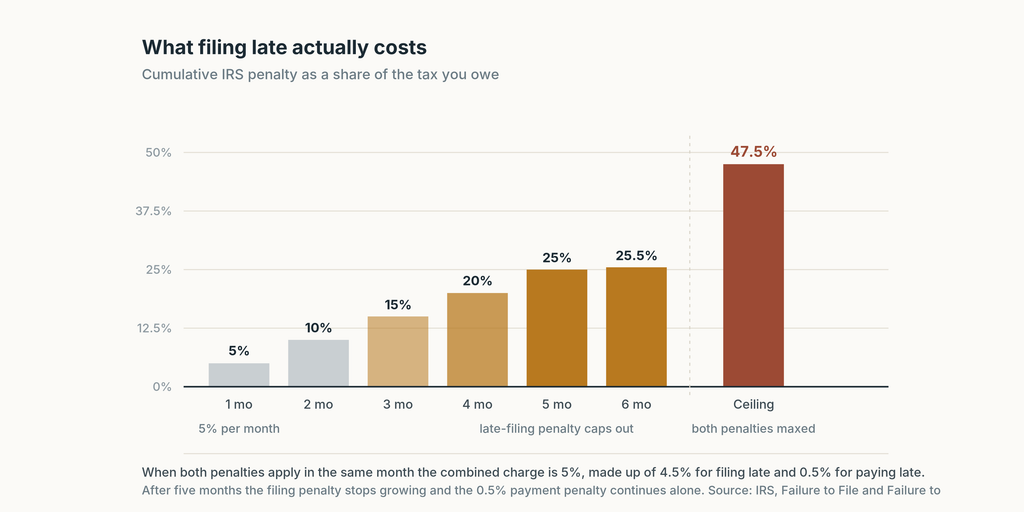
The IRS failure to file penalty is 5% of the unpaid tax for each month or part of a month your return is late, up to a maximum of 25%. If the return is more than 60 days late, the minimum penalty is $525 for returns required to be filed in 2026 or 100% of the tax owed, whichever is less.
The failure to pay penalty is 0.5% of unpaid tax per month, also capped at 25%. It rises to 1% per month if the tax is still unpaid 10 days after the IRS issues a notice of intent to levy and drops to 0.25% while an approved payment plan is in place.
Stacked together, the maximum combined penalty for filing and paying late is 47.5% of the tax owed.
Two things follow from those numbers. Filing late costs ten times more per month than paying late, so file even if you cannot pay in full. And an extension gives you more time to file, not more time to pay.
One expectation to set early: Cleanup gets you accurate books. It does not guarantee a particular tax outcome and preparing or amending returns is usually a separate engagement. Ask upfront whether filing is included.
How to Choose a Catch-Up Bookkeeping Service
Online service, independent bookkeeper or CPA firm?
Online services are consistent and often cheaper, but you may not get the same person twice. An independent bookkeeper gives you continuity and direct access, though capacity is limited. A CPA firm costs more and makes sense when tax filing and the cleanup should sit with one team.
The cheapest quote is often the most expensive. An underqualified provider can leave the books worse and the next person charges to undo the work before starting theirs.
Ten questions to ask before signing:
- Is this catch-up, cleanup or both?
- What is your not-to-exceed price?
- What happens if you find more than expected?
- Exactly which months and accounts are in scope?
- Is tax filing included?
- What deliverables do I receive?
- Who does the actual work?
- What is the timeline?
- What do you need from me and by when?
- What happens after the catch-up is finished?
What you should receive at the end: reconciled bank and card accounts, an adjusted trial balance, a profit and loss statement and balance sheet for each period, the general ledger, a documented opening balance and a written summary of assumptions and anything left unresolved.
Red flags: no diagnostic before quoting, no written scope, no price cap, vague deliverables and pressure to pay the full amount upfront.
After the Catch-Up: Staying Current
The habits are simple. Keep business and personal money in separate accounts. Connect your bank feeds and check them monthly. Capture receipts as you go rather than at year-end. Pick one day each month to close the books and lock the period once it is done. If monthly close is not going to happen reliably in-house, move to ongoing bookkeeping services before the next backlog builds. Catching up once is a project. Falling behind every year is a system problem and it costs far more over time.
Frequently Asked Questions
What is catch-up bookkeeping and how does it work for a small business?
It is the process of recording, categorizing and reconciling transactions for past months that were never entered. The bookkeeper rebuilds each month from your bank statements, then produces reports you can actually file taxes from.
How do I catch up my bookkeeping after falling behind for several months?
Download every bank and card statement for the period first, then work oldest month forward. Reconcile each month fully before starting the next one and fix the balance sheet at the end.
What are the best catch-up bookkeeping services for a small business owner?
The best fit depends on your setup, not on brand names. Choose a provider who runs a diagnostic first, gives a written scope with a price cap and has experience with your industry, software and entity type.
How much does catch-up bookkeeping usually cost in the US?
Published 2026 ranges run roughly $300 to $3,500 for simpler backlogs and $1,500 to $6,000 or more for complex ones. Price follows the number of accounts, transaction volume and condition of the records, not just months behind.
What is the fastest way to get my books caught up before tax time?
Gather all statements before anyone touches the software, since missing paperwork is the biggest delay. Then hire a provider who can start immediately and work on parallel months, rather than attempting it yourself alongside running the business.
Conclusion
If your books are behind, the useful first step is not requesting a price. It is a short review of your file so you know what is actually wrong, what the scope really is and what a fixed price should look like before you commit to anything.
That is where Runwell Books starts with every client. Get your books assessment and we will tell you whether you need catch-up, cleanup or both, along with a clear scope and a fixed number.
For more practical guides on bookkeeping, payroll and sales tax for small businesses, visit the Runwell Books blog.
One Response